Paddle along the Eastlake shore or stroll to the end of a Westlake street and you will see them: rows of houses floating on the water, connected by narrow docks, with flower boxes, kayaks tied alongside and front doors that open onto the lake. Seattle's floating homes have become a symbol of the city, as recognizable to many visitors as the Space Needle. One of them famously appeared in the 1993 film Sleepless in Seattle. But the community's history is a lot less glamorous, and a lot more interesting, than the movies suggest.
From floating shacks to landmark homes
Seattle's earliest houseboats were working-class housing. HistoryLink notes that loggers and sailors, whose work was seasonal, built floating shacks from scrap lumber so they could live rent-free in the off season. As the Ship Canal was dug, migrant workers looking for cheap housing tied floating shanties to pilings wherever they could, and by 1914 there were a couple hundred houseboats on Lake Union.
The Great Depression brought an explosion of floating homes. According to the Floating Homes Association, there were more than 2,000 houseboats in Seattle by the late 1930s, and some estimates run closer to 3,000. Many of the floating homes still on the water today date from that era.
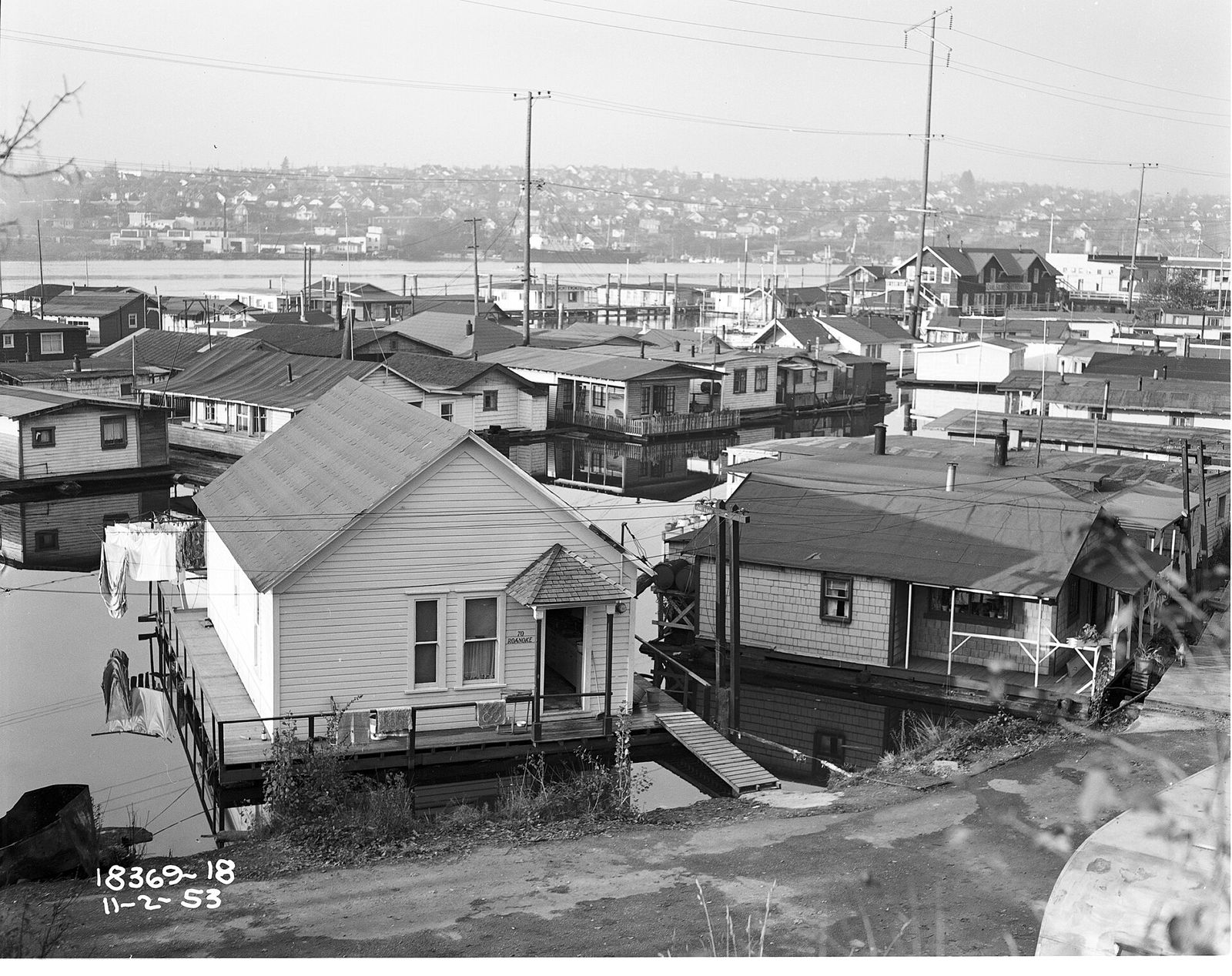
After World War II, the city turned against them. Concerns about sewage were real, since Lake Union had long received raw sewage, but they were also used as a weapon against houseboaters by people who wanted the waterfront for other things. Evictions came in waves: HistoryLink records that about 100 houseboats on Roanoke Bay were evicted in 1958 for new apartments and marina expansion, and dozens more on Portage Bay were displaced by freeway construction. By the early 1960s, fewer than 1,000 floating homes remained.
In 1962, houseboaters organized the Floating Homes Association. Its members tackled the sanitation problem head-on, and the Portage Bay-Lake Union sewer line, completed in 1965, required homes to hook up. That, as HistoryLink's Eastlake history puts it, assured the long-term survival of the community. Activists such as Terry Pettus organized residents and pressed the City Council through the 1960s and 1970s, and the association joined Eastlake neighbors in a legal fight against the Roanoke Reef, a condominium complex begun over the water at the foot of Roanoke Street in 1971. The half-built structure was eventually demolished, and new floating homes took its place.
Today the Floating Homes Association says that roughly 500 floating homes and 250 residential houseboats remain, almost entirely on Lake Union and Portage Bay. Once cheap, rough housing, they are now carefully regulated and widely admired.
Floating home, houseboat or barge?
Locals use "houseboat" loosely, but the Floating Homes Association draws some useful distinctions:
- Floating home
- A type of houseboat with permanent connections to sewer, water, electricity and sometimes gas, tied to a specific moorage. Seattle's construction codes apply to floating homes much as they do to houses on land.
- Floating on water residence (FOWR)
- A movable floating structure that can travel between marinas.
- Barge
- Another type of houseboat. In the early 1900s, the city gave a special designation to 36 original "house barges." Barges are not allowed to have motors.
- Liveaboard
- A conventional boat that someone lives on full-time in a marina. See marinas and moorage.
Where to see them
Most of the floating homes are clustered along the eastern shore in Eastlake, along Westlake on the west shore, on Portage Bay and along the north shore. The docks themselves are private, but there are good public vantage points:
- From the water. A kayak, paddleboard or small rental boat is the classic way. See kayaking and boat rentals.
- Terry Pettus Park in Eastlake sits right between floating home docks and has a public float for paddlers.
- Public street ends around the lake, many of them on the Cheshiahud Loop, look out over the water and the docks.
- The Cheshiahud Loop passes many of the communities; see the loop guide.
- Floating home tours. The Floating Homes Association has periodically opened selected homes to the public for a Floating Home Tour, its best-known public event.
Etiquette
These are people's homes, and the docks are private property. A few simple courtesies go a long way:
- Do not walk onto private docks or tie up to private floats.
- From the water, keep a respectful distance and keep your voice down; sound carries across water.
- Do not photograph residents or peer into windows.
- Use public parks, street ends and public floats to stop and enjoy the view.
What is it like to live afloat?
The Floating Homes Association describes the community as exceptionally tight-knit, often feeling like an extended family for its residents. Practically, modern floating homes have the same utilities as houses on land: the Floating Homes Association explains that wastewater is pumped from a sealed tank into the city sewer, and homes are hard-wired to city water and power. Each floating home is tied to a designated moorage, which makes ownership different from owning a house on land. If you are curious about buying, the association's FAQ is a good place to start.
Floating landmarks
Some of the lake's floating history is preserved in public. At Lake Union Park, the floating structures of The Center for Wooden Boats, along with its Old Boathouse, also known as the Wagner Floating Home, are a designated City of Seattle landmark. A visit makes a nice pairing with a houseboat paddle; see museums.
Sources and further reading
- HistoryLink: Seattle's houseboats
- HistoryLink: Eastlake, Seattle neighborhood
- Seattle Parks: Shoreline Boating Access list (PDF)
- Descriptions of individual businesses and organizations are based on their own published information, checked when this guide was written. Details change, so confirm directly before you visit.