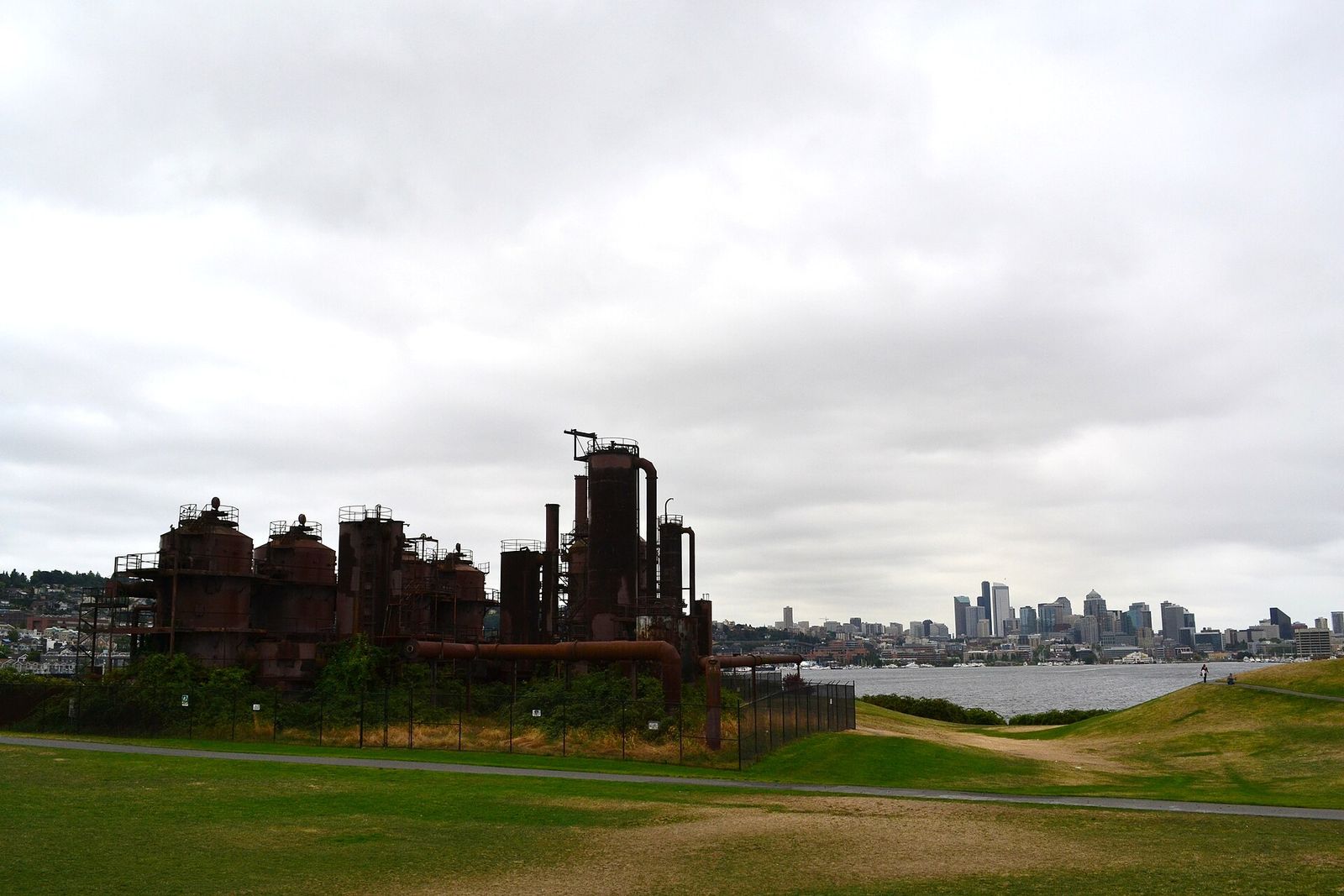
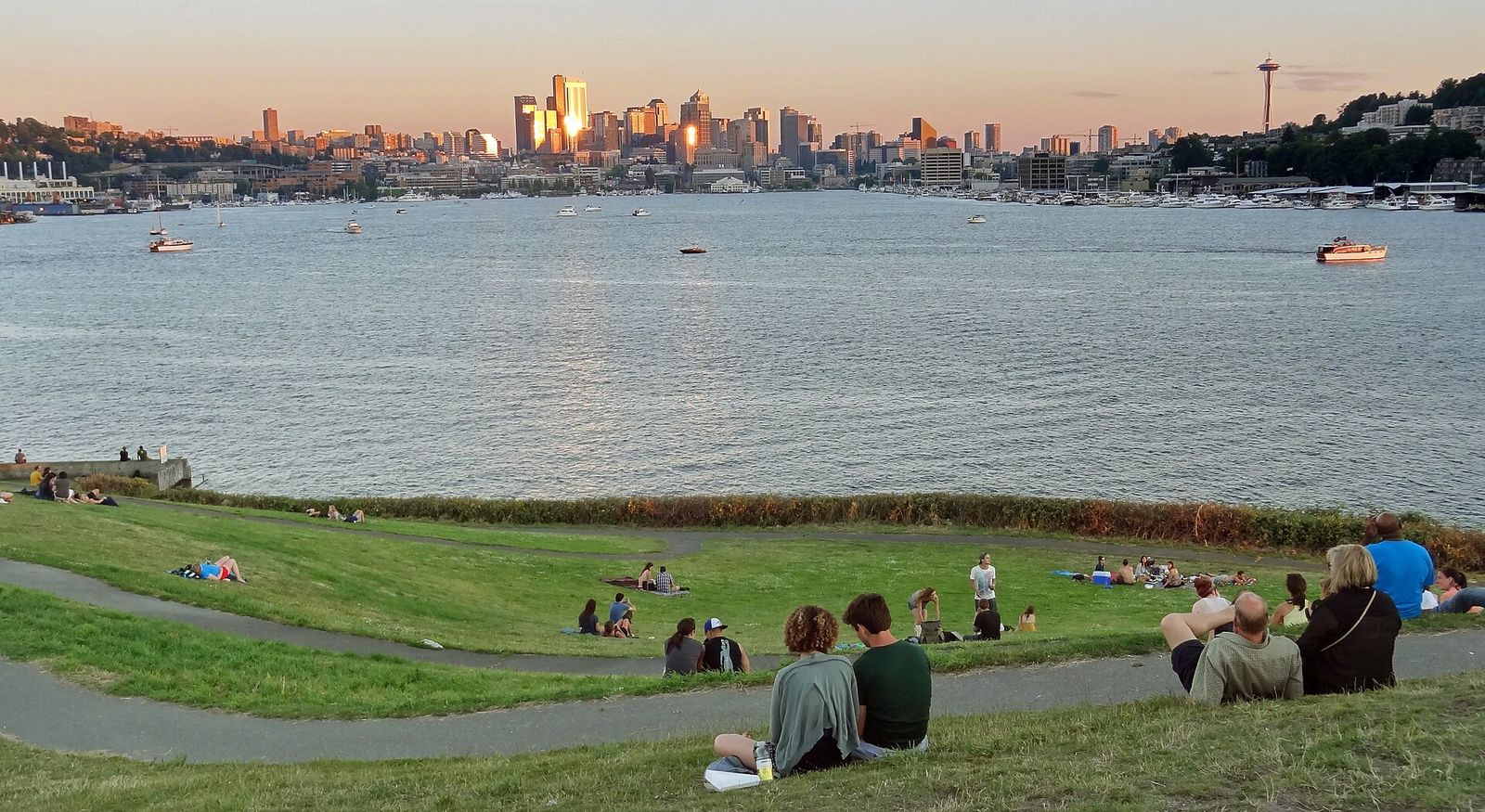
There is no park quite like it anywhere. On a point of land jutting from the north shore of Lake Union, the towers of an old gas plant rise out of grassy lawns, painted and weathered, framed by kites, picnic blankets and a constant parade of boats on the water below. Climb the hill to the west and the whole lake opens up in front of you, with the Space Needle and the downtown towers lined up along the far shore.
Gas Works Park is at 2101 N Northlake Way, on the Wallingford waterfront between Fremont and the University District. It is a designated Seattle Landmark and is listed in the National Register of Historic Places.
From gas plant to park
The point was first suggested for a park in the Olmsted Brothers' 1903 plan for Seattle's park system. Instead, in 1906 the Seattle Gas Light Company acquired about 19 acres here and built a plant that turned coal into gas to light the city. The site needed lots of fresh water, which is part of why the lakeshore made sense. In 1937 the company switched to oil, adding new machinery and towers, and during World War II barges and tankers unloaded oil at the plant's dock. Production finally ended in December 1956, to the relief of the Wallingford neighbors who had lived with its smoke and smell for half a century.
In 1962, the city, led by City Council member Myrtle Edwards, began buying the site for a park. The plan at the time was conventional: tear everything down and bring in fill. Landscape architect Richard Haag had another idea. He spent time at the abandoned plant, came to see the hulking machinery as something worth keeping, and proposed a park that would recycle the relics rather than haul them away. He also proposed cleaning the polluted soil on site by plowing it up and letting air, sunlight and bacteria do their work, a technique he tested on a plot before winning the commission.
The city approved Haag's master plan in 1972. The big earthen hill, built partly from fill excavated for an office tower in the University District, opened to the public on August 31, 1973, so people could watch the transformation of the rest of the site. The park was fully open by July 1976. Today it is recognized as a pioneering example of turning an industrial site into public open space, and the "Gas Works" name has stuck for good.
What to see
The towers
The tall structures at the heart of the park are the plant's gas generator towers and their processing equipment. They are fenced for safety, but you can walk right around them, and they are a favorite backdrop for photographs at every time of day.
The play barn
The plant's old pump house, also known as the exhauster building, was converted into a covered children's play barn filled with brightly painted machinery. Outside, a refurbished piece of plant equipment has become a climbing structure.
Kite Hill and the sundial
The Great Mound, better known as Kite Hill, is the park's high point. On breezy days it fills with kites, and at its summit is a sculptured sundial made of concrete, shells, glass, bronze and other materials by local artists Chuck Greening and Kim Lazare. Stand on the right spot and your own shadow tells the time.
The view
The south-facing lawns look straight down Lake Union to the city. Seaplanes take off and land in the middle distance, sailboats tack across the lake, and on clear evenings the skyline lights up as the sun goes down.
Rules: why you cannot go in the water
As inviting as the shoreline looks, swimming, wading, fishing and launching boats are prohibited at Gas Works Park. The reason is in the lake bottom: Seattle Parks notes that sediment offshore contains hazardous substances left over from the plant's industrial years. The Washington Department of Ecology oversees a cleanup plan for the lake sediment next to the park, so expect occasional construction or restrictions along the water's edge. If you want to paddle from this part of the lake, the nearby Sunnyside Avenue North Boat Ramp just to the east is a public launch; see getting there.
Fourth of July at Gas Works
Gas Works Park is one of the classic places in Seattle to watch the Fourth of July fireworks over Lake Union. The organizer, Seafair, has run the celebration at the park with free admission tickets required for entry, gates that open in the afternoon and close well before the show, and fireworks after dark. Parking is scarce on the day, and Lake Union Park on the south shore is the flatter, paved alternative. Details change from year to year; see events.
Visiting tips
- Getting there: The park has a parking lot, which fills on sunny weekends. The Burke-Gilman Trail runs along the north edge of the park, making it easy to arrive on foot or by bike from Fremont or the University District.
- Picnics: Seattle Parks lists reservable picnic areas here, including the picnic shelter adapted from an old plant building.
- Kites: Bring one. The hill catches the wind off the lake.
- Golden hour: Sunset and the hour after are the best time for photos of the skyline and the towers.
- Combine it: Walk the north shore of the Cheshiahud Loop, or head east to the restaurants along Northlake Way; see waterfront dining.
Nearby on the north shore
Northlake Way is a mix of marine businesses, offices and a few waterfront restaurants. Westward sits on the water just east of the park, and further east along Northlake Way is Ivar's Salmon House. Boaters often know the area for Fisheries Supply, the marine store on Northlake Way, and for Lake Union Hot Tub Boats, which launches from the north shore.
Sources and further reading
- Seattle Parks and Recreation: Gas Works Park
- HistoryLink: Gas Works Park (Seattle)
- Wikipedia: Gas Works Park
- Seattle Parks and Recreation: Sunnyside Ave N Boat Ramp
- Descriptions of individual businesses and organizations are based on their own published information, checked when this guide was written. Details change, so confirm directly before you visit.