Before it was Lake Union, before there was a Seattle, this was a small, quiet lake between two bigger bodies of water. Its history since then is a story of people trying to connect things: freshwater and saltwater, forests and markets, neighborhoods and the shore. Here is that story, in brief.
The little lake
Lake Union was carved by the Vashon glacier at the end of the last ice age, the same ice that shaped Lake Washington and Green Lake. For thousands of years it was home and highway to Native people. In Lushootseed the lake is known as x̌ax̌čuʔ, meaning "small lake," and in Chinook Jargon, the 19th-century trade language, it was Tenas Chuck, "small water." Travelers moving between Lake Washington and Puget Sound used it as part of a natural route of rivers, portages and bays that people followed long before any canal was dug.
Duwamish people lived in villages on the lake. Seattle Parks notes that Cheshiahud, known as Lake John, served as a guide for early settlers and that Duwamish villages persisted along the lake for some 25 years after the Denny party claimed land here in 1853. As late as 1909, Cheshiahud lived at the foot of Shelby Street on Portage Bay. The lake loop trail bears his name.
A "union of waters"
On July 4, 1854, pioneer Thomas Mercer proposed giving the lake a new name. Mercer imagined that a canal would one day link Lake Washington, this lake and Puget Sound, a "union of waters," and so he called it Lake Union. It would take 63 years for his prediction to come true.
In the meantime, settlers put the lake to work. Pioneer David Denny and others claimed land on its shores. In the 1860s Harvey Pike acquired land between Lake Union and Lake Washington and even began digging a channel. Coal from mines east of Lake Washington was barged across the lakes and carried by tram over the Montlake isthmus, then across Lake Union, and from 1872 a narrow-gauge railroad hauled it from the foot of today's Westlake Avenue to a coal dock downtown. In 1882 Denny's Western Mill opened at the south end of the lake, and in the 1880s workers, including Chinese laborers, cut small channels at Montlake and toward Salmon Bay that could float logs and small boats between the waters.
Building the Ship Canal
A true ship canal had to wait for federal money and an engineer with a plan. Hiram M. Chittenden of the U.S. Army Corps of Engineers took charge of the Seattle district in 1906 and designed the canal that exists today: the Fremont Cut between Salmon Bay and Lake Union, the Montlake Cut between Lake Union and Lake Washington, and a set of locks at the west end of Salmon Bay. Before the canal, Lake Washington sat about 29 feet above sea level and Lake Union about 20 feet. To save money, Chittenden skipped a second set of locks at Montlake, which meant Lake Washington would have to be lowered to the level of Lake Union.
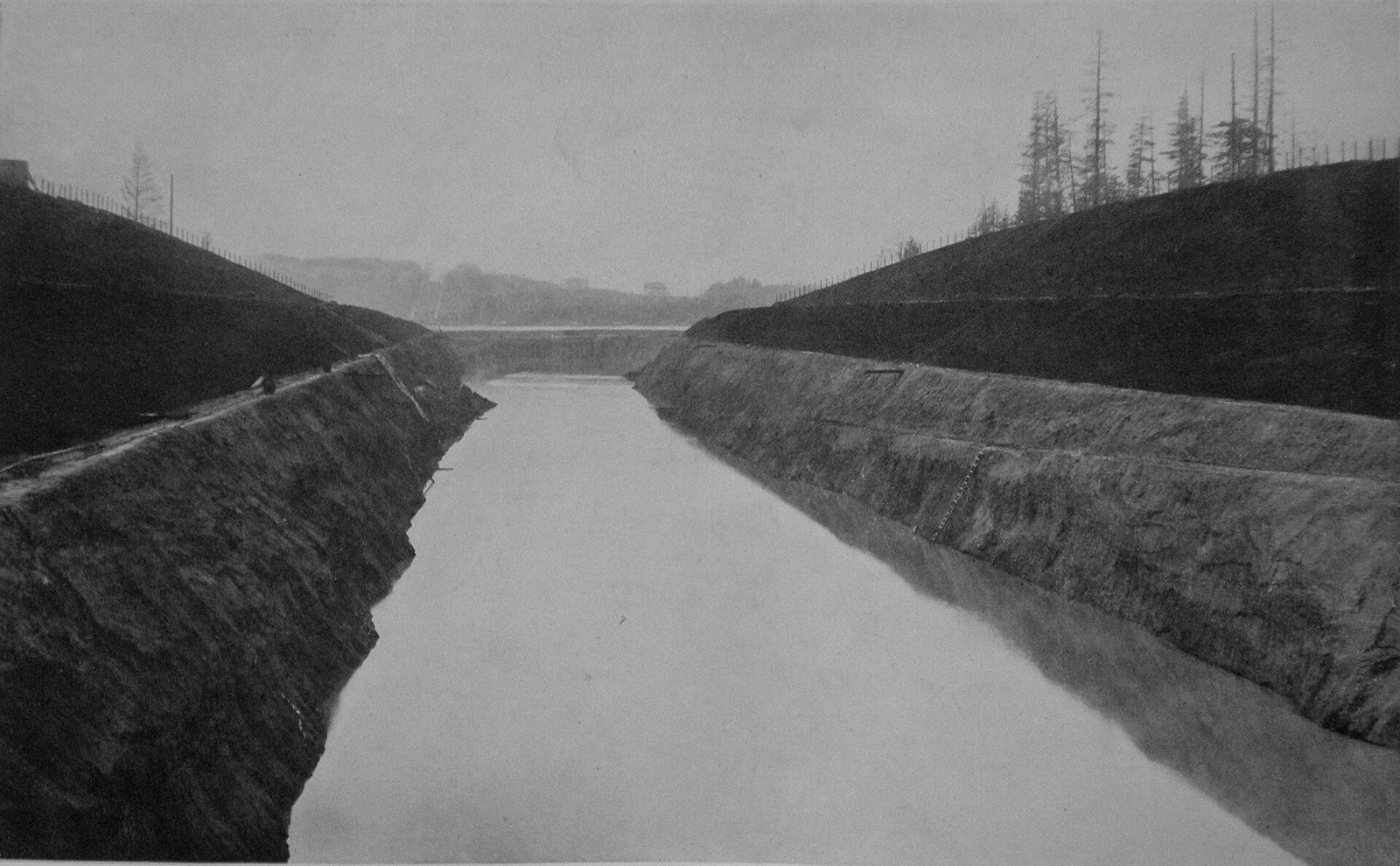
Digging at Montlake began in 1909. On July 12, 1916, the gates of the new locks were closed and Salmon Bay began to fill, turning the tidal inlet into a freshwater reservoir. On August 25, 1916, the Corps began the long-awaited "union of the waters" by breaching the cofferdam at Montlake. Over the following months Lake Washington dropped about nine feet. Its old outlet, the Black River, dried up, and new shoreline appeared all around the big lake.
The canal was formally celebrated on July 4, 1917, exactly 63 years after Mercer's prediction. The steamer Roosevelt locked through and led a parade of more than 200 boats through the cuts and across Lake Union into Lake Washington. In 1956 the locks were renamed the Hiram M. Chittenden Locks, though almost everyone still calls them the Ballard Locks.
The bridges
The canal needed crossings, and Seattle chose bascule drawbridges that could open for ships. The Fremont Bridge opened on June 15, 1917, the first of four city bascule bridges over the canal, followed by the Ballard Bridge, the University Bridge in 1919 and the Montlake Bridge in 1925. High above them all, the Aurora Bridge has carried State Route 99 over the west end of Lake Union since it opened on February 22, 1932, George Washington's 200th birthday. Its deck is about 167 feet above the water.
The working lake
With the canal open, Lake Union became a freshwater harbor in the middle of the city. Shipyards, sawmills, machine shops and marine businesses crowded its shores. In 1906 a gas plant was built on the north shore point that would one day become Gas Works Park. On June 15, 1916, William E. Boeing flew his first airplane, the B&W floatplane, from the lake; see seaplanes. The Lake Union Drydock Company was founded on the east shore in 1919 and is still repairing vessels today.
During the Great Depression, the lake's houseboat colonies swelled with people looking for cheap housing. As World War II approached, the Navy took over the site of Denny's old mill for a Naval Reserve center, and in 1940 the Art Moderne Naval Reserve Armory was built at the south end of the lake.
Reclaiming the shore
After the war the lake slowly turned toward the public. The gas plant closed in 1956, the city bought the site in 1962, and Richard Haag's groundbreaking park opened in stages in the 1970s. Houseboaters organized the Floating Homes Association in 1962 and, with a new sewer line completed in 1965, secured their community's future; see houseboats. Small street-end parks and the Cheshiahud Loop opened more of the shoreline to walkers.
At the south end, decades of planning finally produced Lake Union Park, formally dedicated on September 25, 2010. In 2012 the Museum of History & Industry moved into the old Naval Reserve Armory, where its windows look out on the water that shaped the city. Today Lake Union is still a working lake, home to shipyards, seaplanes and fishing boats, but it is also one of Seattle's favorite places to play.
Learn more
The best place to dig deeper is the lake itself: visit MOHAI and the Center for Wooden Boats at Lake Union Park, and walk the Cheshiahud Loop. HistoryLink, the free online encyclopedia of Washington state history, has detailed essays on the canal, the neighborhoods and the parks, linked in the sources below.
Sources and further reading
- HistoryLink: Lake Washington Ship Canal
- HistoryLink: Cascade/South Lake Union neighborhood
- HistoryLink: First Boeing airplane flies from Lake Union
- HistoryLink: Lake Union Park opens
- HistoryLink: Gas Works Park
- HistoryLink: Seattle's houseboats
- Wikipedia: Lake Union
- Wikipedia: Fremont Bridge (Seattle)
- Wikipedia: George Washington Memorial Bridge (Aurora Bridge)
- Seattle Parks and Recreation: Cheshiahud Lake Union Loop